Female Scammer Katherine Luis
Female Scammer Katherine Luis
E-mail:
★★★★☆ 8 ratings
Scam Danger:
 |
Details |
|
| First Name: | Katherine |
| Location [Address]: | |
| Age: | |
| Birth Date: | |
| Aliases: | |
Reports :
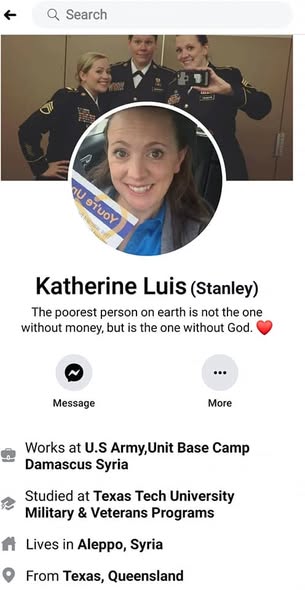
I never imagined I would find myself caught in something like this. It started so simply—just another day scrolling through Facebook, seeing familiar faces, random posts, and then a friend request that seemed harmless at first. The profile looked genuine. The photos showed a woman in military uniform, confident and friendly, someone who appeared to be serving overseas. There was nothing immediately suspicious about it. In fact, everything about the profile was carefully put together to appear trustworthy.
After accepting the request, the conversations began. At first, they were casual and polite. The person introduced herself as “Katherine Luis (Stanley)” and claimed to be working with the U.S. Army stationed at a base in Syria. She spoke about her life, her duties, and how lonely it felt being far away from home. The tone was warm, engaging, and at times even comforting. It felt like talking to someone real—someone who understood emotions, who listened, and who responded with empathy.
As days passed, the conversations became more frequent and more personal. There was a gradual shift from casual chatting to emotional connection. Stories were shared—about hardships, about being stationed in a dangerous place, about not having anyone to trust. The narrative was consistent: a hardworking individual, alone in a foreign land, looking for someone to talk to and rely on.
Looking back now, I realize how carefully everything was crafted. The profile included details that made it seem legitimate—education at Texas Tech University Military & Veterans Programs, a hometown connection, and a current location in Syria. Even the photos seemed authentic, showing a person in uniform alongside others, smiling and appearing completely normal. It never crossed my mind that those images could have been stolen.
Then came the emotional hooks. The conversations turned deeper, more personal, and more urgent. There were stories of financial difficulties, restrictions on accessing personal funds due to military deployment, and the need for help. It was presented in a way that didn’t immediately feel like a request—it was more like sharing a burden, building sympathy first before ever asking for anything.
Eventually, the requests came. They were framed carefully—not as demands, but as desperate pleas. There were explanations about needing assistance to process documents, to receive a package, or to solve some urgent issue that couldn’t be handled locally. Each request was accompanied by reassurance: promises to repay, expressions of gratitude, and even emotional attachment.
At that point, confusion started to set in. Something didn’t feel right. The situation seemed too complicated, too urgent, and too dependent on outside help. The more I thought about it, the more inconsistencies began to appear. Why would someone in the military need financial help from someone they had only recently met online? Why were there always urgent problems that required immediate action?
I began to question things more directly. That’s when the tone shifted slightly. There was a sense of pressure—subtle, but noticeable. The urgency increased. The emotional language intensified. It became less about conversation and more about getting me to act quickly.
That’s when I decided to step back and investigate further. I looked closely at the profile, the photos, and the information provided. A reverse image search revealed that the pictures had been used elsewhere under different names. That was the moment everything became clear.
The profile was fake.
All the conversations, the stories, the emotional connection—it was all part of a calculated scam. The person behind the account was not who they claimed to be. They were using stolen photos and fabricated details to create a believable identity. The goal was simple: gain trust, build emotional connection, and then exploit that trust for financial gain.
Realizing this was both frustrating and unsettling. It wasn’t just about the attempt to get money—it was about the manipulation. The time spent building trust, the personal conversations, the emotional investment—it was all used as a tool.
What makes this situation even more concerning is how convincing everything was. The profile didn’t look like an obvious scam. It was detailed, consistent, and believable. The approach wasn’t aggressive or suspicious at first. It was gradual, patient, and carefully planned.
This experience has been a wake-up call. It highlights how easily anyone can be targeted and how sophisticated these scams have become. It’s no longer just about obvious fake profiles or poorly written messages. These scammers take the time to build a story, create a persona, and engage in real conversations to gain trust.
I am sharing this not just as a personal experience, but as a warning. People need to be aware that profiles like this exist. They may appear genuine, but behind them are individuals with one goal—to manipulate and exploit.
If there is one thing to take away from this, it is to always remain cautious. No matter how real someone seems online, it’s important to verify, to question, and to trust your instincts. If something feels off, it probably is.
This was not about friendship or connection. It was a calculated attempt to take advantage of trust. And while I was fortunate to recognize the signs before any real damage was done, others may not be as lucky.
Awareness is the only way to fight this.
Related Female Scammers:






Rate this Profile
Romance Scams Must read
- Dating Scams Are BIG Business
- Why scammers use fake docs?
- How to Recognize Scammer
- Asian And Chinese Online Dating Scam
- How to Recognize a Female Dating Scammer
- 10 Practical Steps to Stay Safe From Online Romance Scams
- Prevent Internet Dating Scams Using These 4 Tips
- How Romance Fraudsters Use Photoshop
- Avoid Internet Dating Scams With These 4 Practical Tips
- Gold & Romance Fraud Scenarios Led by Female Scammers
- Meeting a Model and Birthday Scam Scenarios
- Ukraine Online Dating Scams
- A Typical Translation Scam Scenario
- Online Dating Scams: The Costly Travel Scenario
- 10 Ways to Check Who You Are Chatting With
Popular Links

NEWS & EVENTS
The world's most prevalent social network said that to date, it has acquired lawful judgments of about $2 billion against deceitful exerci

SWINDLERS LIST
-
Top 10 Scammers !!!
Beware of these scammers...Keep them out of your mail-box...
SCAM TOOLS
-
Block Scam Mails???
Cleaning your scam filled inbox can be effected by these tools
HELP DESK
-
Waiting to help You!!!
Every problem has a solution when discussed. Discuss with us to get a clear idea to keep your information unscathed from hypocrites